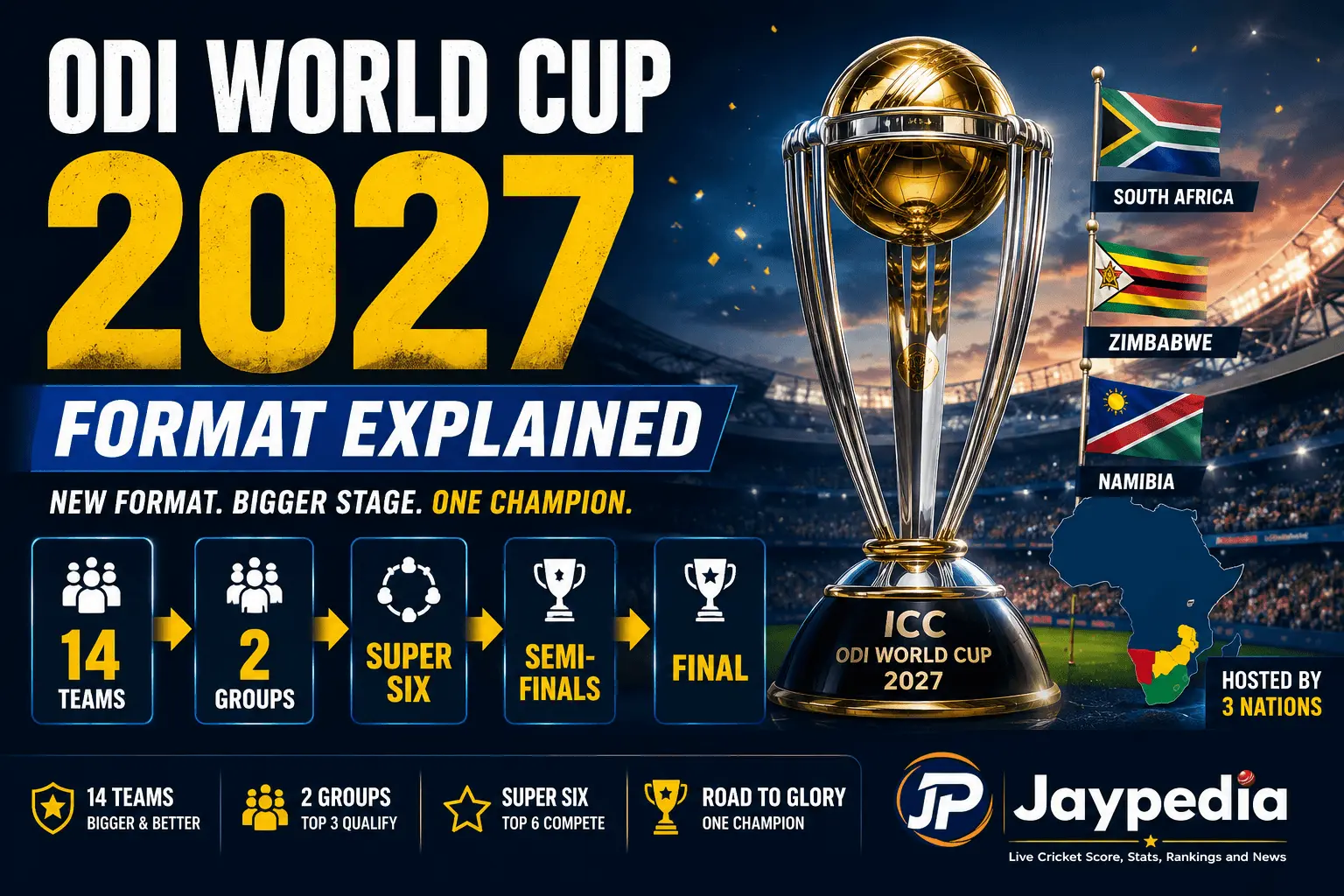
Learn the ODI World Cup 2027 format, Super Six rules, qualification process, points system, teams, hosts, and major changes from the 2023 World Cup.
Table of Contents
- ICC ODI World Cup 2027 Format Explained: Complete Guide to Teams, Super Six and Qualification
- Key Takeaways: ODI World Cup 2027 Format
- ODI World Cup 2027 Format at a Glance
- ODI World Cup 2027 Format Flow
- ICC World Cup 2027 Format Explained
- ODI World Cup 2027 Teams and Group Structure
- ODI World Cup 2027 Super Six Format Explained
- ODI World Cup 2027 Points System Explained
- Hypothetical Example: How the ODI World Cup 2027 Points System Could Work
- Example Super Six Standings
- How Do Teams Reach the Semi-Finals?
- Why Did ICC Bring Back the Super Six Format?
- ODI World Cup 2027 vs ODI World Cup 2023 Format
- Is the ODI World Cup 2027 Format Better Than the 2023 Format?
- ODI World Cup 2027 Qualification Process
- History of ODI World Cup Formats
- Cricket World Cup Winners List (1975–2023)
- Key Things to Know About the ODI World Cup 2027 Format
- Conclusion
- Sources & References
- Frequently Asked Questions (FAQs)
ICC ODI World Cup 2027 Format Explained: Complete Guide to Teams, Super Six and Qualification
The ODI World Cup 2027 will introduce one of the biggest format changes in modern cricket history. Following the 2019 and 2023 editions, which featured only ten teams competing in a single round-robin league stage, the International Cricket Council (ICC) has decided to expand the tournament to 14 teams and reintroduce the Super Six stage.
South Africa, Zimbabwe, and Namibia will jointly host the tournament. It will be the first ODI World Cup hosted across three African nations and the first World Cup in Namibia’s history.
The ICC World Cup 2027 format has already become one of the most discussed topics among cricket fans because it combines traditional World Cup structures with a modern qualification pathway. The return of the Super Six stage means every group match could have a significant impact on a team’s journey to the knockout rounds.
In this guide, we explain the ODI World Cup 2027 format, the Super Six system, the qualification process, the points structure, the historical context, and everything fans need to know ahead of the tournament.
ODI World Cup 2027 Format at a Glance
| Feature | Details |
|---|---|
| Tournament | ICC Men’s Cricket World Cup 2027 |
| Format | One Day International (ODI) |
| Hosts | South Africa, Zimbabwe, Namibia |
| Teams | 14 |
| Groups | 2 |
| Teams per Group | 7 |
| Super Six Teams | 6 |
| Semi-Finalists | 4 |
| Finalists | 2 |
| Total Matches | 54 |
| Defending Champions | Australia |
ICC World Cup 2027 Format Explained
The ICC World Cup 2027 format will feature 14 teams divided into two groups of seven teams each.
Every team will play six matches during the group stage, facing each opponent in its group once.
At the end of the group stage:
- The top three teams from Group A qualify.
- The top three teams from Group B qualify.
- The remaining eight teams are eliminated.
The six qualified teams then progress to the Super Six stage before the semi-finals and final.
This format differs significantly from the 2023 World Cup, which included 10 teams competing in a single league table, with the top four advancing directly to the semi-finals.
ODI World Cup 2027 Teams and Group Structure
The ODI World Cup 2027 will include 14 teams.
Although the final list of qualified teams has not yet been confirmed, the tournament structure is already known.
Group A
7 Teams
Group B
7 Teams
Each team will play:
- 6 group-stage matches
- 1 match against every other team in its group
This creates 42 group-stage matches in total.
The top three teams from each group then move to the next stage.
ODI World Cup 2027 Super Six Format Explained
The return of the Super Six stage is the most significant feature of the ODI World Cup 2027 format.
The six qualified teams will be:
- A1
- A2
- A3
- B1
- B2
- B3
Teams do not replay opponents from their original group.
Instead, they face only the qualified teams from the opposite group.
For example:
India, Australia, and Pakistan qualify from Group A.
South Africa, England, and New Zealand qualify from Group B.
India would play:
- South Africa
- England
- New Zealand
Australia would play:
- South Africa
- England
- New Zealand
Pakistan would play:
- South Africa
- England
- New Zealand
This creates nine Super Six matches.
After these matches are completed, a combined Super Six standings table determines which teams advance to the semi-finals.
ODI World Cup 2027 Points System Explained
One of the most important aspects of the ODI World Cup 2027 format is the points carry-forward system.
The ICC has confirmed the return of the Super Six stage, although the detailed tournament playing conditions are yet to be published.
Historically, teams carried points earned against other qualifying teams into the Super Six stage.
This meant results against eliminated teams were generally not carried forward.
As a result, every match against a strong opponent became extremely valuable.
This system prevents teams from starting the Super Six stage with a completely clean slate.
Instead, earlier performances continue to matter.
Hypothetical Example: How the ODI World Cup 2027 Points System Could Work
Let’s assume the following teams qualify.
Group A
| Pos | Team | Points | Status |
|---|---|---|---|
| 1 | 🇮🇳 India | 10 | Qualified |
| 2 | 🇦🇺 Australia | 8 | Qualified |
| 3 | 🇵🇰 Pakistan | 6 | Qualified |
| 4 | 🇧🇩 Bangladesh | 4 | Eliminated |
| 5 | 🇦🇫 Afghanistan | 2 | Eliminated |
| 6 | 🏴 Scotland | 1 | Eliminated |
| 7 | 🇳🇱 Netherlands | 1 | Eliminated |
Qualified:
- India
- Australia
- Pakistan
Group B
| Pos | Team | Points | Status |
|---|---|---|---|
| 1 | 🇿🇦 South Africa | 10 | Qualified |
| 2 | 🏴 England | 8 | Qualified |
| 3 | 🇳🇿 New Zealand | 6 | Qualified |
| 4 | 🇱🇰 Sri Lanka | 4 | Eliminated |
| 5 | 🇿🇼 Zimbabwe | 2 | Eliminated |
| 6 | 🇳🇦 Namibia | 1 | Eliminated |
| 7 | 🇺🇸 USA | 1 | Eliminated |
Qualified:
- South Africa
- England
- New Zealand
Now assume:
- India defeated Australia
- India defeated Pakistan
- Australia defeated Pakistan
Because Australia and Pakistan qualified, India’s victories against them may carry forward into the Super Six stage.
However, if India defeated Bangladesh during the group stage, that result may not carry forward because Bangladesh failed to qualify.
This is why every match against likely qualifying teams becomes extremely important.
A team could enter the Super Six stage with a significant advantage before playing a single new match.
Example Super Six Standings
| Pos | Team | Carried Points | Super Six Points | Total | Status |
|---|---|---|---|---|---|
| 1 | 🇮🇳 India | 4 | 4 | 8 | Semi-Final |
| 2 | 🇿🇦 South Africa | 4 | 2 | 6 | Semi-Final |
| 3 | 🇦🇺 Australia | 2 | 4 | 6 | Semi-Final |
| 4 | 🏴 England | 2 | 2 | 4 | Semi-Final |
| 5 | 🇵🇰 Pakistan | 0 | 2 | 2 | Eliminated |
| 6 | 🇳🇿 New Zealand | 0 | 0 | 0 | Eliminated |
The top four teams qualify for the semi-finals.
This example shows why the ODI World Cup 2027 points system could make every group-stage match more meaningful than in previous editions.
After understanding the tournament format, check the latest ODI World Cup 2027 Qualification Tracker to see which teams have qualified and how the remaining spots will be decided.
How Do Teams Reach the Semi-Finals?
After the Super Six stage concludes:
1st Place vs 4th Place
2nd Place vs 3rd Place
The winners of the two semi-finals will compete in the ODI World Cup 2027 final.
Only four teams will remain in contention for the trophy at this stage.
Why Did ICC Bring Back the Super Six Format?
One of the biggest talking points surrounding the ODI World Cup 2027 format is the return of the Super Six stage.
The ICC moved away from the Super Six system after the 2003 Cricket World Cup and experimented with different formats over the next two decades. The 2019 and 2023 editions featured only ten teams playing in a single league stage.
While that format ensured every team played each other, many fans and cricket experts felt it limited opportunities for emerging nations and associate teams.
The return of a 14-team tournament aims to:
- Increase global participation.
- Give associate nations a better chance of qualifying.
- Create more meaningful matches.
- Reduce the risk of early elimination due to a difficult fixture list.
- Expand cricket’s global reach.
The ODI World Cup 2027 will therefore become the largest Cricket World Cup since the 2015 edition.
ODI World Cup 2027 vs ODI World Cup 2023 Format
Many fans have asked how the ODI World Cup 2027 format differs from the ODI World Cup 2023 format.
The table below highlights the major changes.
| Feature | ODI World Cup 2023 | ODI World Cup 2027 |
|---|---|---|
| Teams | 10 | 14 ▲ |
| Groups | No | Yes ▲ |
| League Structure | Single Round Robin | Two Groups |
| Super Six | No | Yes ▲ |
| Semi-Finalists | 4 | 4 |
| Matches | 48 | 54 ▲ |
| Qualification Opportunities | Limited | Expanded ▲ |
| Associate Nation Participation | Lower | Higher ▲ |
The biggest difference is the return of the Super Six stage, which introduces an additional phase before the semi-finals.
Is the ODI World Cup 2027 Format Better Than the 2023 Format?
There is no simple answer.
Supporters of the new format believe it will:
- Increase competitiveness.
- Encourage wider participation.
- Help cricket grow in emerging nations.
- Produce more knockout-style pressure.
However, critics argue that:
- The Super Six stage can be difficult for casual fans to understand.
- Points carry-forward systems may create confusion.
- Some teams may benefit from easier groups.
Ultimately, the success of the ODI World Cup 2027 format will depend on how competitive the tournament becomes and how well the Super Six stage is received by fans.
ODI World Cup 2027 Qualification Process
The qualification process for the ODI World Cup 2027 is already underway.
The qualification pathway includes:
- ICC ODI Rankings
- ICC Cricket World Cup League 2
- ICC Challenge League
- Qualifier Play-Offs
- Cricket World Cup Qualifier
Teams must earn their place through a combination of rankings and qualification tournaments.
The exact qualification pathway allows both Full Members and Associate Members to compete for a place in the World Cup.
This system ensures that emerging nations still have an opportunity to qualify for the tournament.
History of ODI World Cup Formats
The Cricket World Cup has evolved significantly since its inception in 1975.
Each era introduced different tournament structures based on the number of participating teams and the growth of the game worldwide.
| Year | Teams | Format |
|---|---|---|
| 1975 | 8 | Groups and Knockouts |
| 1979 | 8 | Groups and Knockouts |
| 1983 | 8 | Groups and Knockouts |
| 1987 | 8 | Groups and Knockouts |
| 1992 | 9 | Round Robin |
| 1996 | 12 | Groups and Knockouts |
| 1999 | 12 | Super Six |
| 2003 | 14 | Super Six |
| 2007 | 16 | Super Eight |
| 2011 | 14 | Groups and Knockouts |
| 2015 | 14 | Groups and Knockouts |
| 2019 | 10 | Round Robin |
| 2023 | 10 | Round Robin |
| 2027 | 14 | Super Six Returns |
The ODI World Cup 2027 marks the return of the Super Six stage for the first time since 2003.
Cricket World Cup Winners List (1975–2023)
The ICC Men’s Cricket World Cup has produced some of the most memorable moments in cricket history.
Australia remain the most successful team in tournament history, while India, the West Indies, Pakistan, Sri Lanka, and England have also lifted the trophy.
| Year | Winner | Runner-Up | Result |
|---|---|---|---|
| 1975 | 🏆 West Indies | Australia | West Indies won by 17 runs |
| 1979 | 🏆 West Indies | England | West Indies won by 92 runs |
| 1983 | 🏆 India | West Indies | India won by 43 runs |
| 1987 | 🏆 Australia | England | Australia won by 7 runs |
| 1992 | 🏆 Pakistan | England | Pakistan won by 22 runs |
| 1996 | 🏆 Sri Lanka | Australia | Sri Lanka won by 7 wickets |
| 1999 | 🏆 Australia | Pakistan | Australia won by 8 wickets |
| 2003 | 🏆 Australia | India | Australia won by 125 runs |
| 2007 | 🏆 Australia | Sri Lanka | Australia won by 53 runs (DLS) |
| 2011 | 🏆 India | Sri Lanka | India won by 6 wickets |
| 2015 | 🏆 Australia | New Zealand | Australia won by 7 wickets |
| 2019 | 🏆 England | New Zealand | England won on boundary count after tie |
| 2023 | 🏆 Australia | India | Australia won by 6 wickets |
Most Successful Teams in ODI World Cup History
| Rank | Team | World Cup Titles |
|---|---|---|
| 🥇 | Australia | 6 |
| 🥈 | India | 2 |
| 🥈 | West Indies | 2 |
| 🥉 | Pakistan | 1 |
| 🥉 | Sri Lanka | 1 |
| 🥉 | England | 1 |
Australia will enter the ODI World Cup 2027 as defending champions.
Key Things to Know About the ODI World Cup 2027 Format
Beyond the basic tournament structure, there are several important aspects of the ODI World Cup 2027 format that could have a major impact on how teams progress through the competition.
Every Group Match Could Matter
Because points may carry forward into the Super Six stage, teams cannot afford to relax after securing qualification.
Victories against other qualifying teams could become crucial later in the tournament.
Net Run Rate Could Become Even More Important
Teams finishing level on points may be separated by Net Run Rate (NRR).
A single heavy defeat or big victory could influence qualification.
Associate Nations Have More Opportunities
The expansion from 10 to 14 teams opens additional qualification places.
This increases the chances of seeing emerging cricket nations compete on the biggest stage.
The Format Rewards Consistency
Unlike a straight knockout tournament, teams must perform well across multiple phases to reach the final.
Conclusion
The ODI World Cup 2027 format represents one of the biggest changes in modern one-day cricket.
The tournament will feature 14 teams, two groups, a Super Six stage, semi-finals, and a final. It also marks the return of a format last seen at the 2003 Cricket World Cup.
While some details, including the final points carry-forward rules, are still expected to be confirmed by the ICC, the overall structure is already generating significant interest among cricket fans worldwide.
The expanded format provides greater opportunities for emerging nations while maintaining a competitive pathway to the knockout stages.
As qualification races continue and more tournament details are announced, the ODI World Cup 2027 is shaping up to be one of the most anticipated events in cricket history.
Sources & References
Frequently Asked Questions (FAQs)
What is the ODI World Cup 2027 format?
The tournament will feature 14 teams divided into two groups, followed by a Super Six stage, semi-finals, and a final.
How many teams will play in the ODI World Cup 2027?
A total of 14 teams will participate.
Who will host the ODI World Cup 2027?
South Africa, Zimbabwe, and Namibia will jointly host the tournament.
What is the Super Six stage in cricket?
The Super Six is a second-round stage where the top three teams from each group compete for semi-final places.
How many teams qualify for the Super Six stage?
Six teams qualify, with the top three teams from each group advancing.
How many matches will each team play in the group stage?
How many matches will be played in the ODI World Cup 2027?
The tournament will feature 54 matches.
Will points carry forward into the Super Six stage?
A carry-forward system is expected, although the ICC has yet to publish the final playing conditions.
How many teams qualify for the semi-finals?
The top four teams in the Super Six standings will reach the semi-finals.
What is the difference between the 2023 and 2027 World Cup formats?
The 2023 World Cup had 10 teams and a single league table, while the 2027 World Cup will feature 14 teams and a Super Six stage.
Why did ICC expand the World Cup to 14 teams?
The expansion aims to improve global participation and provide more opportunities for emerging nations.
Which team is the defending champion?
Australia are the defending ODI World Cup champions.
Has the Super Six format been used before?
Yes, it was used in the 1999 and 2003 Cricket World Cups.
What is Net Run Rate (NRR)?
Net Run Rate is a statistical measure used to separate teams that finish level on points.
How does qualification for the ODI World Cup 2027 work?
Teams qualify through ICC rankings and official qualification tournaments.
Can associate nations qualify for the ODI World Cup 2027?
Yes, associate nations can qualify through the ICC qualification pathway.
Which countries are hosting the ODI World Cup for the first time?
Namibia will host World Cup matches for the first time.
Which team has won the most ODI World Cups?
Australia hold the record with six World Cup titles.
When will the ODI World Cup 2027 be played?
The tournament is expected to take place during October and November 2027.
Why is the ODI World Cup 2027 important?
It marks the return of the Super Six stage, the expansion to 14 teams, and a major step forward for global cricket development.

Follow IPL, CPL, ICC tournaments, international cricket, rankings, schedules, and live match analysis only on Jaypedia.